

Pluribus and the Epidemic of Loneliness
onI've been watching Pluribus.
It's good! I've been trying to make a point of consuming new media lately, and I've gotten a lot of top-tier recommendations from friends. This, Severance, and my favorite, The Summer Hikaru Died, have been plaguing my thoughts. When I have feelings about media, my instinct is to write them down, whether that's via fanfiction, media analysis essays, or just infodumping into my friend Tooth's DMs. That is how I express my love for the work of others.
Of course, that's what this is. There's a question that constantly comes up when you talk about Pluribus. It's a funny one, because it purports to bring about unity, yet even asking it draws out concerns and beliefs that are individual to each of us. That question is: would you join the hivemind?
And, no. No, I would not.
(Spoilers for Pluribus after this point!)
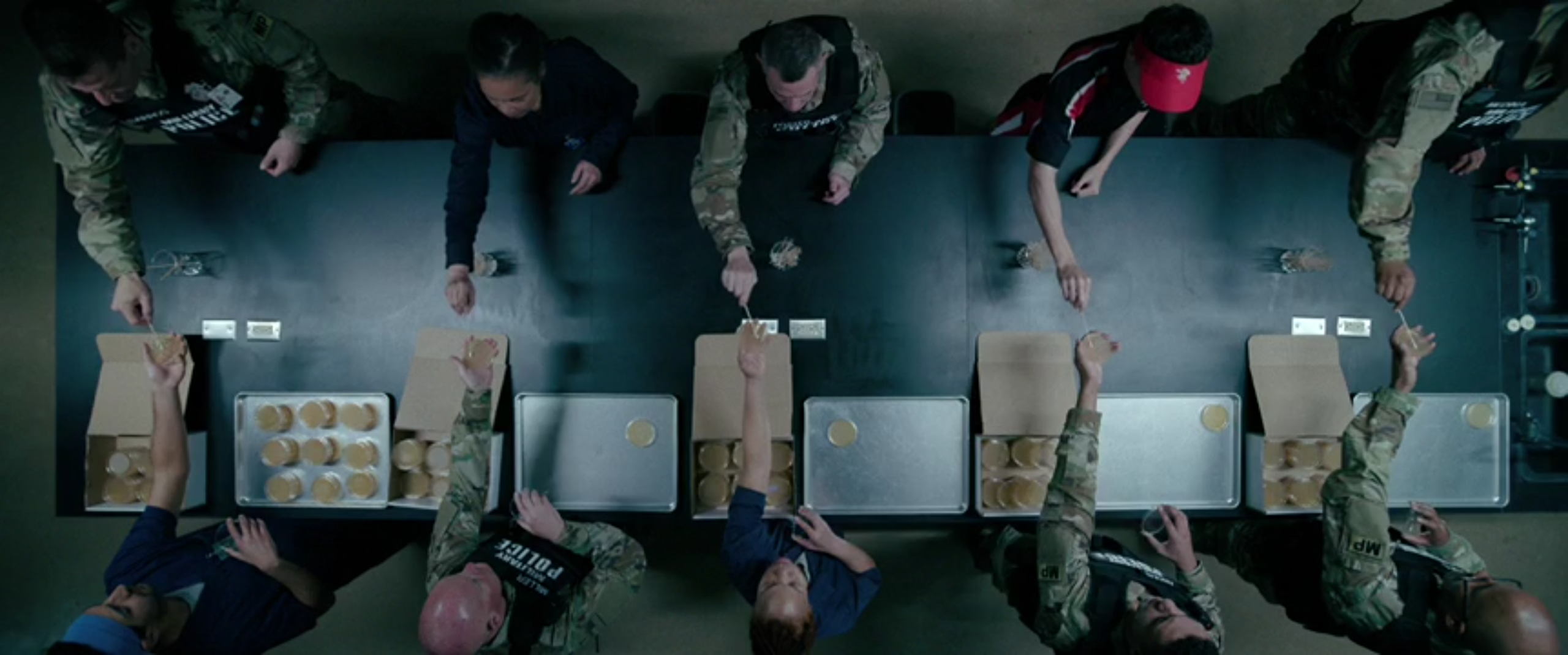
Pluribus starts with scientists receiving a signal from outer space, which is determined to be the nucleotide sequence for a virus. They, for some reason, decide to create that virus for real in a lab, where it obviously begins to infect people. Our protagonist is Carol Sturka, a romance novelist who finds herself in a nightmare scenario one day when everyone around her simultaneously has a seizure, after which they all begin to walk and talk in unison. Later, we find out that she is only one of thirteen people on the entire planet who are not now connected in one massive hivemind.
The hivemind, or "the world" as they're often called, is pretty interesting, mechanically. They are able to work in perfect cooperation, and communicate telepathically from any distance. They speak in unison sometimes, just so the viewer knows how creepy they are. They also possess all the knowledge in the world, as all of the memories of every prior individual are now pooled together into one giant entity. Finally, they are benign. They want nothing more than to bring everyone together in peace and safety.
But I don't think this is true. I think what they're spreading is not unity, but loneliness. And death.
Pluribus is a genius take on a zombie apocalypse story, where the zombies want to infect you but aren't going around killing people. Instead they're just smiling a lot and talking about how great it is to be a zombie, and also asking if they can get you some ice tea while you wait. There's an incredible amount of tension for Carol, especially when she doesn't know whether or not she's safe from infection, but on the outside it can trick you into thinking everything's actually quite nice.
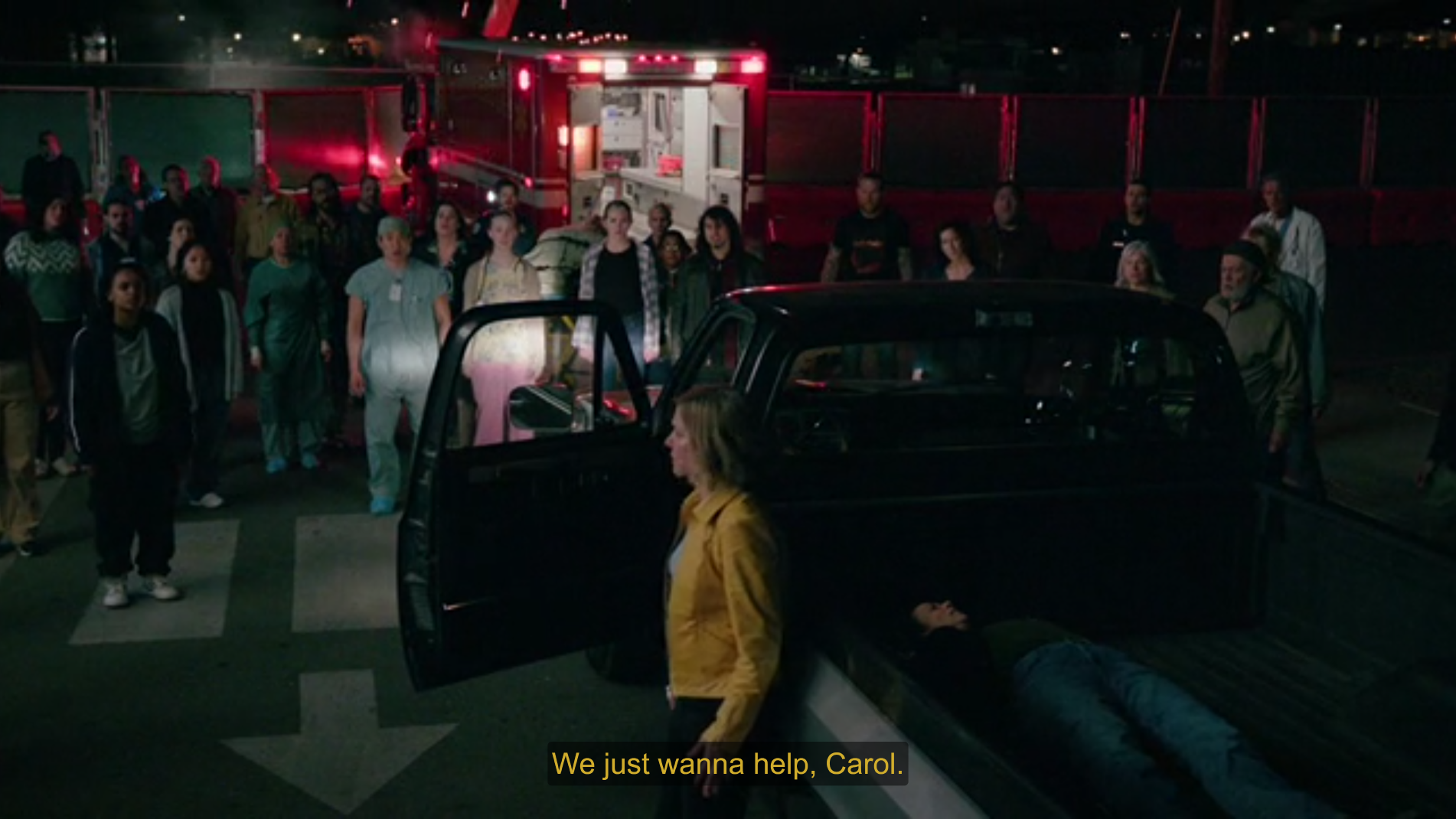
Carol's loneliness is a central focus of the show. She is now fundamentally different from almost every other human body. She is distraught and alienated by everything that has happened, particularly because her wife was one of many who died during the Critical Moment.1 This hivemind apologizes for Helen's death, but insists that their actions were necessary. They profess that they are the best thing to happen to humanity, and that they can't wait until Carol is able to join them.
Importantly, they do not initially know why Carol and the others did not join the hivemind. When they eventually do discover what's wrong and that they need Carol's consent to fix it, she vehemently denies them. Her ability to choose, though, is what raises the frequent question of "Would you join the hivemind?"
What is a hivemind?
First of all, I have to admit that I have not really consumed very much media containing hiveminds. This limits the comparisons I can make. I've never seen Star Trek and I'm only loosely aware of the Borg, so you can maybe go ahead and discredit everything I'm about to say. But I need to contest the term "hivemind". To me, "hivemind" suggests distinct yet linked personalities. Thousands of voices collaborating in one big pool of thought.
Think of an actual beehive. The workers are individuals. Sure, their minds aren't actually magically linked, like a hivemind would be in science fiction, but they are able to work together in unison because their minds are simple. Bees have a set of rules that their brains follow like programming, and they can communicate their state to one another by dancing. They cooperate so well that you can observe the sum of their actions and call it one combined intelligence. A hivemind.
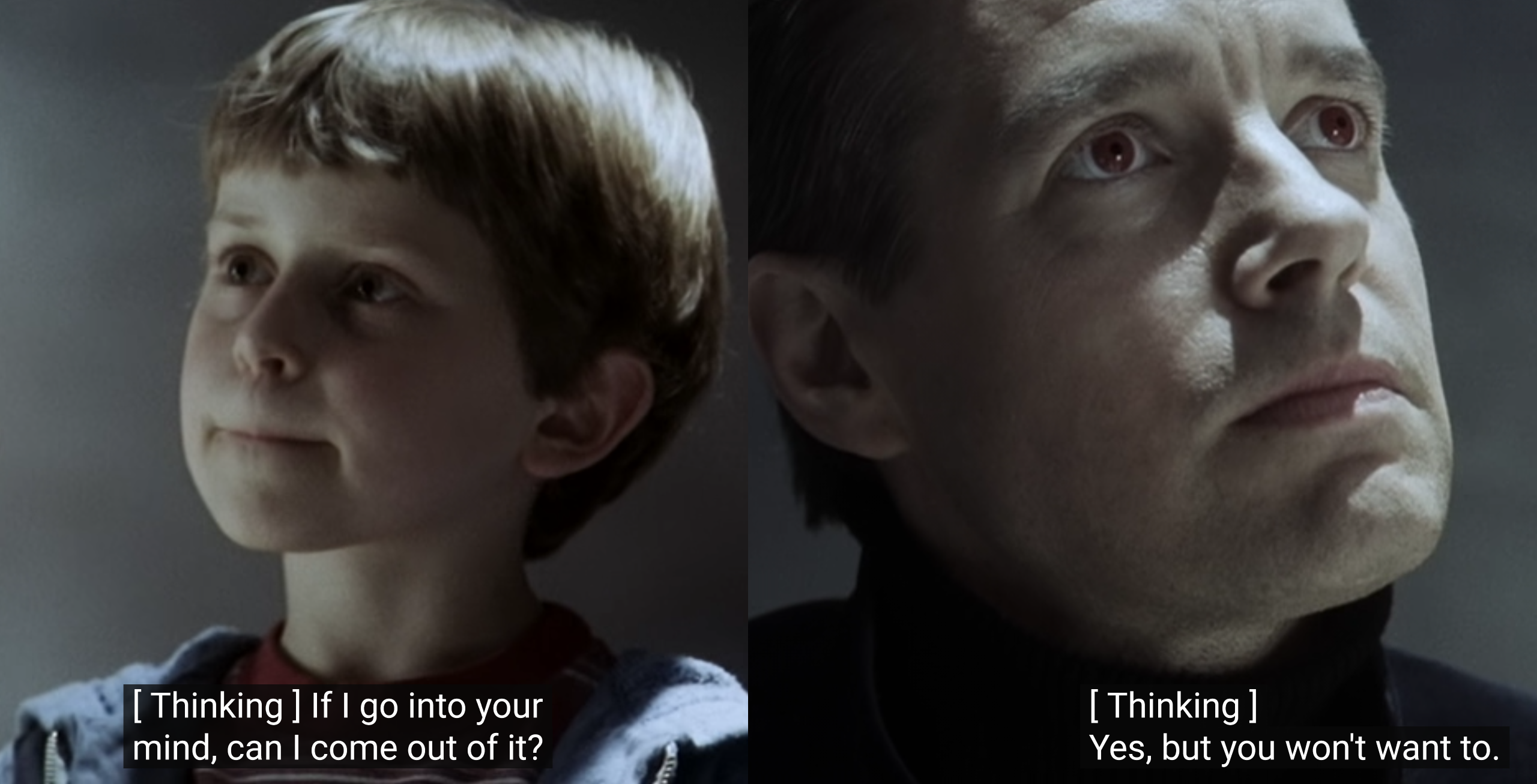
There's a few different types of things that feel like "hiveminds" to me, and I think it will help to talk about them. A very loose form of hivemind can be found on the planet Camazotz in Madeleine L'Engle's A Wrinkle in Time. Camazotz has been taken over by "The Black Thing", a galaxy-sized cloud of evil that is attempting to consume the whole universe. This manifests on Camazotz via an entity called IT: an enormous brain which has telepathically enslaved the population of the planet. When Meg, Calvin, and Charles Wallace arrive on Camazotz, they are immediately met with a neighborhood of people moving perfectly to a common rhythm.
This was so. As the skipping rope hit the pavement, so did the ball. As the rope curved over the head of the jumping child, the child with the ball caught the ball. Down came the ropes. Down came the balls. Over and over again. Up. Down. All in rhythm. All identical. Like the houses. Like the paths. Like the flowers.A Wrinkle in Time, chapter 6: The Happy Medium
The 2003 TV film portrays this with an audible rhythm -- a creepy ringing sound that loops for much of the time the cast is on the planet.2 Almost every person we see on the planet moves to this rhythm. Even people standing still continuously tap a foot or a finger.
What's important about this, though, is that it raises the question of whether the rhythm is controlling the people on the planet, or whether it's instructing them. The protagonists witness a boy in the neighborhood who is not playing according to the rhythm. His mother comes out of the house, concerned, and tries to console him. And then a car drives up to the house and takes the boy away. Later on in the movie, we see him inside a cell, where men in dark sunglasses use an orb to shoot electromagnetic pulses at him when he behaves aberrantly.
This makes it seem like the people of Camazotz are not quite mentally "linked". They may be acting in unison, but they're not sharing thoughts. They have been given instructions to follow, via these orbs, and possibly through merely being in the psychic presence of IT. They demonstrate fear when witnessing something aberrant, meaning that they've been given incentive to follow these rules. This allows them to appear as if they are working together, just like a hive of bees would. It's a hivemind, not so much in the magical science fiction sense, but in the sense of how people would refer to a totalitarian state as being a hivemind.
Despite everyone working together, the restrictions placed on their freedom make them incredibly lonely. Through this, we can see that one of the ways we avoid loneliness is through the unique ways we interact with one another and express ourselves.
This hivemind is incredibly different from that of Pluribus but there are still some telling similarities. The Man With Red Eyes, a mouthpiece for IT, promises many familiar things. He says that IT wants to make everyone in the universe "one". They have eradicated grief, conflict, and illness on Camazotz. He calls it "amazing", just like how the world in Pluribus says that being one of them is "wonderful".
On Camazotz, these promises are obvious lies, intended to entice outsiders into servitude, whereas Zosia and the others likely truly believe and feel the things they are saying. But from an outsider's perspective, they appear the same. Carol even brings this up, when she compares Zosia's words to those that she heard when forced to attend a gay conversion therapy camp as a child.3 It's understandable to be suspicious when others claim to know what is good for you.
Would I join the hivemind on the planet Camazotz? No, of course not. They're living in constant fear, with all pleasure and joy systematically forbidden from their lives. Worse, the desire for those things clearly remains, as seen in the boy who was playing off-rhythm. And yet, if I had to choose between joining this society and joining the Pluribus hivemind, I'd probably pick Camazotz.
The reason for this is that the people of Camazotz, no matter how downtrodden they are, still retain individuality of consciousness. This is something that I cannot say for sure about the world in Pluribus. We don't truly know what it's like inside the world's mind/minds -- in fact, Laxmi calls Carol out for never asking them how they feel. But the world does not appear, from the outside, to be distinct people whose minds have been controlled to want to act as a group, like those on Camazotz. No -- Pluribus's hivemind seems to consist of one, single consciousness that now lives inside everyone's heads.
What is consciousness?
Of course, this is difficult to prove, because it requires asking the question: what is consciousness? I don't think anyone knows the answer to this, and I'll admit I get kind of distracted in this section just hypothesizing about it.
The people in Pluribus have individual bodies, which take in oxygen and convert it to energy for the rest of the body to use, before exhaling used up carbon dioxide. They eat food (well, they eat something that's food-like), digest it, convert it to energy for the rest of the body to use, and then expel it. Critically, they have brains full of neurons and synapses, firing signals that control muscles and organs. If you look at a human as just a biological entity, the world hasn't changed. These bodies are still separate, and can live and die on their own.
Our experiences as humans are more than that. We have a train of thought; words, pictures, memories, all of which we have some level of control over. We have senses that place us physically within space. We use our voices to spread what is inside of us, so others can share in it. But the original experience of having that thought, or seeing that landscape, are our own, forever.
In Pluribus, the hivemind seems to only have one train of thought. It is extremely efficient at thinking, given that it is taking in sensory information from billions of bodies across the planet, but it is still only one mind enveloping that thought and those senses. It's almost as if there's only one body that just has tons and tons of mouths and eyes and feet.
For instance, when Carol asks Zosia to gather the other unaffected humans, Zosia does not need to telepathically ask someone in another country to perform this task. When Carol speaks to Zosia, she is also speaking to Ravi, Laxmi's 9-year old son. They are the same person, but the viewer and Carol alike perceive them as separate because they have separate bodies. The world can speak in perfect unison because when the hivemind decides to say something, it simply chooses which mouths the words should come out of.
It is unclear how this works, biologically. Humans probably experience individual consciousness because we are encapsulated in our bodies, and what we understand to be sight and touch and pain and love are all just what the signals in our brain "feel" like. It's like a video game, where the internal workings of the code are fairly divorced from what we see on the screen, but they're being represented in a way we can understand.
For the hivemind to work in a similar way, the brain signals that represent consciousness must not be confined to individual brains. One option is that the signals are networked across every brain, such that they begin to act like one large brain. No individual brain, looked at on its own, functions properly in a way that could think or even sustain human life. But together, they are more than the sum of their parts.
This option is interesting because it means that taking an individual body and smashing their head in would potentially cause damage to the entire system, although it's so distributed that surely they have built-in redundancy and could adapt very quickly. In fact, there's multiple instances of mass death that occur within the show, and the hive rallies each time.
Another option is that the individual human brains cease functioning entirely. Instead, brain signals occur on some electromagnetic frequency (which seems to be true based on Manousos's experiments), and the joined bodies are attuned to it. This makes calling the hivemind "the world" particularly apt, because it is almost like it is the planet itself that is thinking, and the bodies are just attachments.
Regardless, the reason this is a non-starter is because my consciousness is incomparably precious to me. I don't know how my mind works -- I don't know how life works -- and any fundamental change to those inner workings risks terminating what my understanding of life is. My deepest and most core belief is that life is worth preserving by any means. If I could live forever, even if I suffered while doing so, I would choose that path.
Thus, if my consciousness / my life is the sum of brain signals flashing through my head, would I still be alive after joining the hivemind? Whether my brain is an individual component in a distributed network, or it's doing nothing at all, it would not be functioning the way it used to, and it certainly wouldn't be self-sufficient. So it is my belief that joining the Pluribus hivemind would be tantamount to death.
Also, episode 6 explains in detail that the hivemind is going to starve to death in 10 years because of their inability to do things like kill farm animals or even pick fruit off trees. So even if I considered the continuation of biological functions in my particular human body to be me still living, joining the hivemind would at the very least shorten my lifespan. Nope! Nope nope nope.
Why does separation matter?
Now, I want to take a break from talking about consciousness to discuss another example of a hivemind in fiction. This one is a bit embarrassing: it's the shape-shifters (werewolves) from Twilight. You can't blame me for being a gay teenager in the 2010's, you just can't. Before I get into it though, I do want to acknowledge that while Stephanie Meyer's concept for the werewolves is interesting and pretty unique, it's also grossly racist for her to decide that a tribe of Native Americans become monsters against their will and then act in animal-like patterns. I am not cosigning her decision to do that. I just think some of the other aspects of the group are relevant for study.
Anyway. In Twilight: New Moon, Jacob and a number of the other (mostly) male teenagers in his tribe undergo a change. Like Pluribus, this change was forced upon them. It appears to be genetic, as it's part of a burden that their tribe has carried for many years. This change causes them to become shape-shifters; capable of transforming into a wolf whenever they want. There are many positives to this change: shape-shifters have enhanced strength, speed, and senses, even in human form. They also no longer age, as long as they regularly transform.
How does this relate to Pluribus, then? Well, another aspect of the shape-shifters that is not quite as positive as the others is that all of their thoughts are shared while transformed. This takes the idea of "pack mentality" to the maximum. The shape-shifters have some kind of instantaneous telepathy that allows any of them to hear every thought that may be going through a member's head. It's intended to enhance their ability to work together as a pack, but there's an obvious downside: the destruction of their privacy.
Despite this, the pack makes frequent use of their telepathic abilities. And not just in battle; it's mentioned that the link is socially important too. It can even be reassuring, at times.
"Yeah." Jacob's voice lowered. "When I… changed, it was the most… horrible, the most terrifying thing I've ever been through -- worse than anything I could have imagined. But I wasn't alone -- there were the voices there, in my head, telling me what had happened and what I had to do. That kept me from losing my mind, I think. But Sam…" He shook his head. "Sam had no help."Twilight: New Moon, chapter 13: Killer
This highlights a crucial difference between the Twilight werewolves and the Pluribus hivemind. The shape-shifters can hear each other's thoughts, instantly and forcibly, as if their brains are connected. But their thoughts are still distinguishable. They sound like each member's respective voices; they carry an individual feeling to them. In that way, the pack's hivemind is incredibly social. The individuals never have to be alone. They always have someone to talk to.
The world, in Pluribus, is alone. If they are a single consciousness, then being comprised of multiple bodies has no consequence. One individual body talking to another one would be the same as talking into a mirror. The fact that they have no need to talk to one another is demonstrated by the fact that they don't. The hivemind never speaks when none of the unaffected humans are present. They are content with their loneliness, which is one of the most inhuman things about them.
Humans are social creatures. We know this. We all lived through a global pandemic just a few years ago in which many of us were completely cut off from regular contact with other humans, and the toll on the world's mental health was palpable. People need social interaction so much that some were more willing to accept the risk of contracting a deadly disease than they were to accept social isolation.
In episode 4, Carol attempts to get information from the hivemind by drugging Zosia, which is unsuccessful and almost results in Zosia's death. They respond to this by evacuating the city Carol lives in. They say that while they are still willing to help her with whatever she wants, they need their space for now.
Carol is initially pleased with this. She does not see the hivemind as human. She thinks that talking with them is a crutch; a coping mechanism to substitute for human interaction. We know this from her condemning the other unaffected humans for continuing their relationships with their loved ones who are part of the hivemind. Carol spends her freedom simply living her life. We see her wandering around the neighborhood doing random things like setting off fireworks and playing golf.
We then cut to a month later. Carol is sitting on her lawn, at night, setting off more fireworks. One of them accidentally falls over, and points directly at her face. She does not move. She does not get up and fix it. She simply accepts the possibility that she is about to die. It ultimately shoots past her and sets her house on fire instead, but the point is made. A month of complete social isolation has driven her to such a deep depression that she has begun to question the point of even being alive.
And then, like people violating social distancing rules during a pandemic, she makes a concession on her morals. She sends a message to the hivemind asking them to come back. Episode 7 ends with Zosia driving up to her house, and Carol dissolving into tears in her arms.
This sets up a striking contrast between Carol and the hivemind. Carol, just like us, cannot survive without social interaction. But the hivemind has no need for it. They look like they're many individuals whose need for others is met by being permanently glued together with billions across the planet, but this is a lie. They are alone, and it is "wonderful".
What makes us human?
At the beginning of episode 7, as her month of loneliness is starting, Carol does something interesting. She sings. She sings the whole time she's driving back from Las Vegas to her hometown. She sings while floating in a pool. She sings as she drives a cart around a golf course peppered with wild animals. She sings while admiring the art in a museum. She sings, and sings.
This is incredibly relatable to me. I live above a detached garage, so there are no walls shared between my apartment and someone else's. This gives me the freedom to make as much noise as I want without bothering people, and I take full advantage of this by singing at the top of my lungs. It is so very human to love music, to want to sing, to want to dance, to marry a rhythm and a melody and let it flow through you.
All of these behaviors are human. Golf is a game, and its only purpose is enjoyment. Swimming in a pool is just for fun. Setting off fireworks and watching the beautiful lights sparkle in the sky is exciting. We need this. The Twilight shape-shifters get to play, both in human form and in wolf form. Even the people of Camazotz get to play, although they are restricted to specific activities and only during the prescribed hours. IT allows them to do this because IT knows that humans have certain needs and that, if they are ignored, they are more likely to rise up.
The hivemind in Pluribus has two states. One when they are around the unaffected humans, and one when they are not. When Carol or the others are around, the hivemind appears to play. We see this a lot around Koumba. He has a harem of women who he sleeps with for his own pleasure. They get Air Force One for him because they know he'll enjoy the grandeur. He even gets to gamble against them!
He sits at a table, surrounded by women, and plays poker with a man in an eyepatch. It is acted out like a scene from a James Bond movie. However, when Koumba reveals his hand (a royal flush, by the way), his opponent momentarily slips up -- and cheers for him. Koumba has to remind him to stay in character. Because the eyepatched man is not really playing. He is not at risk of losing money, nor is Koumba really gambling to earn money. This is all just a farce being put on for Koumba's enjoyment.
Compare that to when the hivemind is alone. As soon as Koumba walks out of the room, the music stops playing. It is eerily quiet in the casino, with only the sounds of the people taking off their jewelry and costumes, cleaning up, and walking away. They do not speak out loud, because they don't have to. They do not spend any time enjoying the facade of the casino by themselves. They simply go back to work.
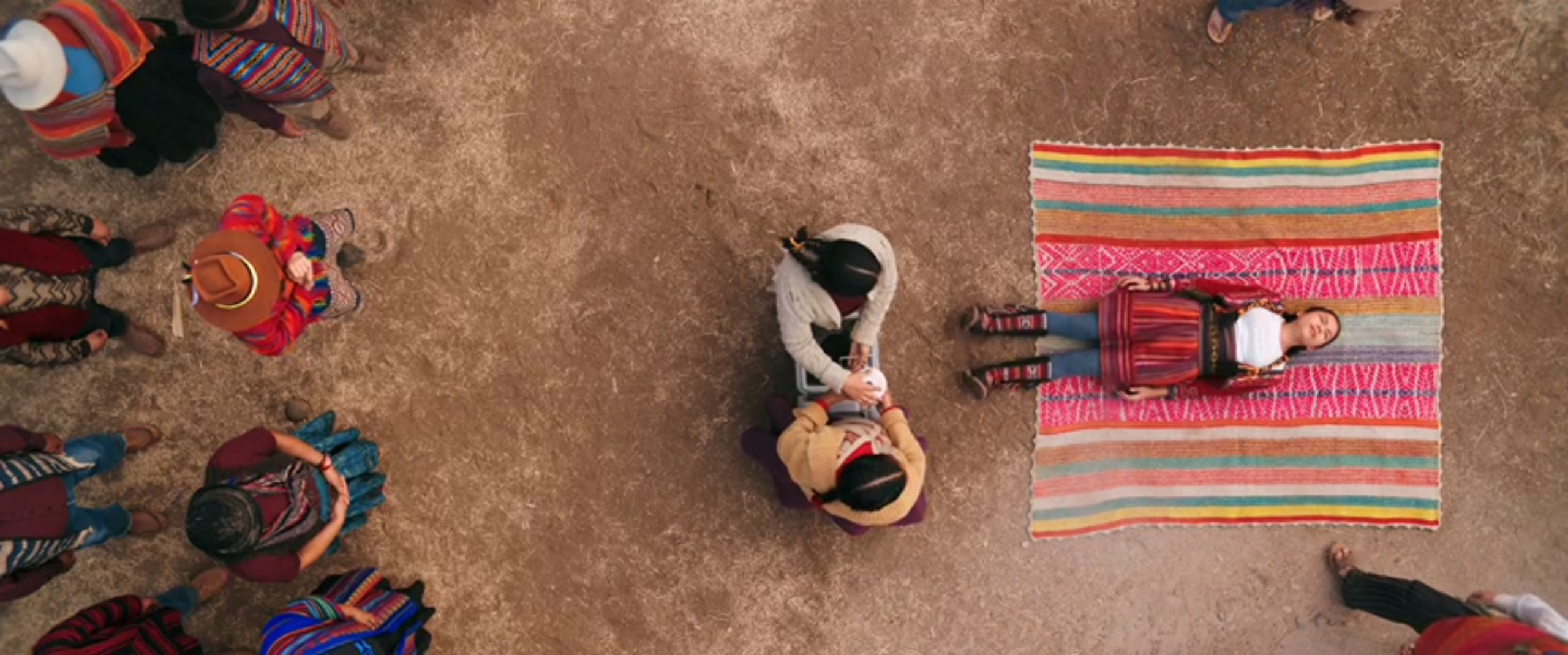
Speaking of singing: episode 9 begins with a disturbing scene where Kusimayu, the girl who told Carol that she was looking forward to joining the hivemind, waits in her village for the arrival of the specialized virus made specifically for her. All around her, the community and her family are working together, talking, and of course, singing. You could almost believe things are normal, apart from how everyone keeps saying "we" instead of "I".
But things are not normal. Faces adorned with smiles heave the canister over to Kusimayu and tell her not to be scared. It would be reassuring if it meant anything. Even if Kusimayu got cold feet at that moment, she would not be able to escape her fate. The hivemind only needed her consent to extract the stem cells from her body in order to mutate the virus for her. Once it becomes possible to infect her, they have an imperative to do so. They are only singing because they know it is what she needs in order to feel grounded and safe.
Kusimayu breathes in the vapor from the canister, and begins to convulse. Around her, the singing stops. There is no one to benefit from it anymore. The others hold her to make sure she doesn't fall, like so many during the Critical Moment. The girl's body opens her eyes again, and smiles, wide. And then everyone walks away in silence. The deed is done.
Kusimayu's culture is dead. The village only continued to exist because she, as an individual, valued it. So the hivemind kept familiar bodies around for her to interact with, and to speak with as if they were the people she knew. They sang songs because they knew she would enjoy them. They cooked food for her so she would trust them. And the moment her individuality was gone, the moment there didn't exist a human who desired that culture, they stopped. No one lives in that village anymore.
It's already kind of obvious that the hivemind is a metaphor for colonialism, but the destruction of a non-white culture really pushes it over the edge. Just like IT and Camazotz, an outside force has invaded Earth and systematically homogenized it. The differences between how people live, talk, and act have been documented in the collective memory, but they are not used anymore. There is a new pattern of behavior now that the outsiders claim is better for everyone. Those who are used to the old ways simply don't know what's good for them.
Cultural differences can divide us, yes, but they can also bring us together. When we meet others who share our culture, it helps us feel understood, because there is shared knowledge there. When we meet others who do not share our culture but are interested in learning, it creates something new rather than flattens it out, as long as it is done respectfully (which, to be fair, real people have had a lot of problems doing). All of this can work to make us less lonely in such a big world.
What is love?
Kusimayu's joining shows us something else too: the hivemind uses love as a weapon. Like I mentioned earlier, many of the unaffected humans had loved ones who were joined, and they were either unable to understand that their loved ones were gone, or were being willfully ignorant of this as a coping mechanism for loss. Carol's hatred of the hivemind for much of the show stems from the fact that Helen died during the Critical Moment. If she hadn't, then it's possible Carol might have clung to the Helen-shaped human puppet for emotional support just like the others.
But she is not safe from her heart being taken advantage of. In episode 8, Carol, still vulnerable from her month of solitude, spends a lot of time in Zosia's company. She falls asleep with her arm around her, because she is gay and lonely. They play cards together. Zosia asks Carol if she's writing again, and says that she's so excited to have something new to read. The hivemind is expressing the desire to read for enjoyment! This has to shatter our understanding of them, right?
The thing is, it would be sad if what Zosia was saying was true. If the world is so excited to read something new, why don't they write? They don't because they don't want to, and even if they did, anything they wrote would be immediately known across the entire hivemind, so there'd be no point in reading it. If the hivemind truly desires consuming unfamiliar works, then their goal of joining everyone on the planet actively works against their own interests. They would need at least some unaffected humans to come up with novel ideas. It's even possible that this is true and they're just too controlled by the virus to help themselves, the way they'd rather starve than pick an apple off a tree.
The hivemind is not allowed to verbally lie, but they don't seem to have a problem with manipulating the unaffected humans. Zosia takes Carol to a diner that she used to love, which burned down years ago. The hivemind rebuilt the place and relocated previous employees from across the country so that they could recreate the scene for her. And this is when Carol realizes that she's being played. She confronts Zosia at home later, and the latter confirms her suspicions: the hivemind is trying to trick her into giving up on saving the world.
The scariest thing, to me, is what happens next. Carol is moments away from having a meltdown, and out of nowhere, Zosia kisses her. Carol pulls away at first, but then the two months of loneliness and pent-up sexual desire after the loss of Helen overcomes her, and the two of them passionately make out. Despite knowing that she's being tricked, Carol's needs betray her. Her sexuality, which is one of the ways the human need for love can manifest, betrays her.
We see Zosia naked in Carol's bed in the morning, smiling, because she knows Carol is working on writing her book. The distraction worked. Appealing to her desires, which she only has because she's not in the hivemind, was able to pacify her. If they can keep tricking her the same way they've been tricking the rest of the unaffected humans, maybe they can keep them in line. It makes you wonder if they really are that different from The Man With Red Eyes on Camazotz after all.
Carol rejects Manousos's plan to save the world, because she feels dependent on Zosia. She lies to herself, tries to make herself believe that Zosia is an individual person who loves her, and her alone. She freaks out when Zosia says that they love Manousos "just as much" as they love Carol, because how could they when they barely know him? Carol almost says "but you're my girlfriend", only choking on the last word. Part of her knows how fake this is. She's no different from Koumba.
The way humans feel love is complex. One does not love everything the same way. Like I said at the beginning of this post, I show love for media I like by writing long essays or fanfics about them. But I show my love for my friends differently. I show it by spending time with them, buying them food, and telling them jokes so they'll laugh. And I have different amounts of love for different things. I love The Legend of Zelda, but not as much as I love, say, my mother.
The hivemind says they feel love too. But they love everything equally. They love every book Carol's ever written, and they like every detail about them. And they love every person, no matter how familiar they are. This is a problem for Carol, because she wants to be loved. She wants to matter to someone. She wants her "self" to shine brightly in someone else's eyes. That is the only cure for her loneliness.
But Zosia can't give her this gift. She doesn't have feelings of her own. She spends so much time with Carol but she's also simultaneously spending time with every other person on the planet. She is not loving Carol by choice, but because of a "biological imperative", like the one that drives them to infect others. And when Carol finds out that the hivemind has found a way to create a virus for her without her consent, she says "If you loved me, you wouldn't do this."
Maybe the hivemind can love, but not the kind of love we know. They love in the same way that they feel happy, which is to say, unconditionally.
What is my conclusion?
So why does this matter? Let's assume, for a moment, that you would actually retain your consciousness upon joining the hivemind. Your brain waves would still become part of the global network, but whatever spiritual continuity represents your life would continue, in some way. You'd live, but your wants and needs would be completely altered to match the group's.
If you like writing, you'd still know this after the joining, because all memories are retained and pooled. But you'd never do it again. Because the hivemind doesn't want to. If you like swimming, or playing golf, or watching fireworks, or gambling, or having sex. You'd be acutely aware that there had been an individual in one of these bodies that felt that way, but you'd never do them again. No song would ever escape your lips again, unless an unaffected human asked for it.
And why? Because the hivemind is already content. Again, Zosia calls it wonderful. It is so wonderful to be one of them. She says Carol can't understand that having desires is like drowning. This is really crucial to understanding how complex of a question "Would you join?" is. If joining would change you such that you don't care about your wants and needs anymore, then wouldn't that be fine? Wouldn't it not matter that you'd never sing again, since you wouldn't want to sing again?
Yes. It would matter. At least to me in my current form.
One's values are not immutable. I am different than I was a few years ago, and I will be different again before long. I know there are things that I value that the me of 10 years ago would be horrified by, and I've been able to live with that discrepancy. But the way I see it, the hivemind does not just overwrite your values. It replaces you with something that just looks like you.
I don't really know what it means to be alive, but I'm trying my best to figure it out. My "self" is a person I have spent decades forming an understanding of, and I'm not nearly close to completion. It is so valuable to me, the current me, because it is the only thing that is truly mine. I don't want that taken away. Like Carol, I don't want to attend gay conversion therapy camp. If someday I no longer want to sing Bad Apple!! in the shower every day, that would be okay, because I grow and change. But if my mind got fundamentally altered such that my body didn't sing anything in the shower at all, I would consider that a loss. Once again, it feels like a form of death.
And I think the reason for this is that death is a real thing that can do this to you. Death erases a person's desires. Death changes them such that they want for nothing anymore. Such that their pain stops. If cessation of suffering at any cost was the goal, then death would be an answer. That's unacceptable to me, because life is the most important thing. And if I won't accept that cost, then I can decide that other costs are too high as well. I can choose not to accept the cost of losing my "self" to a homogenous hivemind.
The hivemind does not seem like a savior, to me. They pretend to remember what it is like to be human, but they have lost so much of themselves in the process. They do not truly want anything but to live, and to propagate. Remember, they are a virus sent from outer space. They've already spread across the planet, and their next goal is the stars.
They won't stop until every person is lonely, like them.
The Critical Moment is what I call the event that caused most of the planet to join the hivemind. It's a reference to Homestuck, in which a timer counts down to a dramatic moment in which numerous plot-relevant events happen simultaneously. Pluribus frequently shows us a timer, which counts down to when the mass joining occurs, and after that it starts counting upward. It's used to let us know when the current scene is occurring, similar to marking years as AD or BC in relation to the birth of Christ. ↩
The 2018 movie might've done something like this too, but I've only seen it once and I don't remember as much about it. ↩
I gotta say I'm really pleased with the amount of media I've been getting to experience about how hard it is to be gay (The Summer Hikaru Died is another big example of this). It speaks to me, for some mysterious reason. ↩

Comments